 Bnbscan
 connects BNB Smart Chain transactions with address and token records
Bnbscan is a BNB Smart Chain explorer for looking up transactions, addresses, blocks, and token contracts. A transaction hash identifies a particular transaction, while an address reveals its balances and recorded activity. Token records help distinguish native BNB movements from transfers handled by a token contract. The explorer also provides contract tools, NFT records, gas information, and network analytics. Transaction status describes on-chain execution; a receiving service can apply separate conditions before crediting an account.
· updated
Addresses, transactions, and blocks in the same record trail
Address pages group account activity, transaction hashes identify individual transactions, and block records place included transactions within the chain's ordered history. A transaction includes its sender and any destination, while its block supplies the inclusion context. A token transfer adds a contract-specific asset movement to that transaction. An account history follows one address across transactions; a block record groups many transactions at a particular height.
A contract interaction can produce several transfers. Counting transfer rows as independent signed transactions would misread how those movements relate to their parent transaction.
Search inputs and the records they select
The search box accepts an address, transaction hash, block number, or token query. A full hash targets a specific transaction. An address provides a broader history, while a block number identifies a location in that network's chain. Token names help locate candidates, although the contract address determines which deployed token you examine.
Full identifiers distinguish records more reliably than shortened strings. Token symbols can repeat, and abbreviated addresses omit distinguishing characters. Search results also depend on the network environment. A testnet record doesn't establish a mainnet transfer, even when the same address appears in both places.
Transaction states and execution details
Pending submissions
Pending means the transaction hasn't yet entered a block in the explorer's view. A transaction hash alone therefore doesn't establish execution. Network conditions, transaction pricing, and earlier unconfirmed transactions from the same sender can affect progress.
An unavailable hash and a visible pending transaction describe different observations. Neither proves the intended recipient received the asset. The wallet or sending service can show whether it actually broadcast the transaction.
Successful calls and asset movements
Success means the transaction completed without a top-level execution failure. The destination may be a contract, so its address can differ from the address receiving a token. Transfer records and contract event logs explain asset movements inside that execution.
The native Value field reports BNB attached to the transaction. A BEP-20 amount belongs to its token transfer record. Event logs come from the contract emitting them, so an unfamiliar token's event doesn't establish the asset's authenticity or economic value.
Failed execution
A fee-paying BNB Smart Chain transaction included in a block still incurs a gas charge if execution fails. Reverted execution rolls back the attempted state changes. An out-of-gas error identifies a gas limit below the computation's requirements. The error matters before any repeat submission; changing a fee setting won't repair faulty contract logic.
Reading a BEP-20 transfer across linked records
An expected token receipt raises a specific question: did this contract transfer the asset to the intended address? The lookup connects the transaction's status with its token movements and the recipient's holdings.
| Lookup stage | Record to inspect | Limit of the finding |
|---|---|---|
| Match the network | The transfer's mainnet or testnet environment | A record from another network can't establish this transfer. |
| Find the transaction | The complete transaction hash | A hash alone doesn't establish successful execution. |
| Read the status | Execution status and block inclusion | Pending doesn't establish inclusion in a block. |
| Inspect the token movement | Token contract, amount, and receiving address | The native BNB Value field doesn't measure a BEP-20 amount. |
| Check the recipient's holdings | The address's balance for that token contract | An earlier incoming transfer doesn't establish the current balance. |
| Reconcile the expected receipt | The on-chain receipt and any receiving-service credit | An explorer can't determine an exchange's internal account credit. |
The transfer amount describes that event. The recipient's later balance can differ after other activity. An exchange can also hold tokens on-chain while applying its deposit requirements before updating a customer account.
Token contracts, holdings, and trading activity
Contract identity
Token records combine chain data with descriptive information, including names, symbols, and supplied project details. Match the contract address when distinguishing assets with similar names. A familiar symbol, logo, or reputation label doesn't establish whether a token can be sold. Transfer restrictions and trading behavior depend on the actual contract and the available market.
Balances and holder distribution
A BEP-20 token contract exposes a
balanceOf
function for reading an address's token balance.
The holdings view organizes balances by token contract. Holder statistics count addresses, so the number doesn't equal a count of individual people. A custodial address can represent holdings managed for other users.
Transfers and DEX records
Transfer history records token movements, while the DEX tracker organizes trading activity from supported decentralized exchanges. Its incoming and outgoing amount fields describe the trade's directions. Coverage follows the exchanges the tracker supports, so it doesn't represent every possible venue. Price displays and portfolio valuations depend on available market data; they don't establish an executable sale price.
NFT collections and item histories
NFT records organize collection activity through trades, transfers, and mint events. The tracker distinguishes token standards, including BEP-721 and BEP-1155. A collection contract and token ID identify the item, while its standard determines how ownership or quantities work. An NFT transfer and a sale aren't interchangeable records: a transfer can happen without a purchase. Recorded trade prices describe completed tracked activity, without fixing the price of another transaction.
Contract inspection and spending permissions
Verified source code and contract reads
Contract verification checks whether compiled source code matches the bytecode deployed at a contract address. It gives readers inspectable source code. Verification doesn't certify safe behavior or remove administrative powers. Read functions expose contract data without submitting a state-changing transaction. Proxy-based contracts can require inspecting an implementation as well as the address users interact with.
Approvals and authorized writes
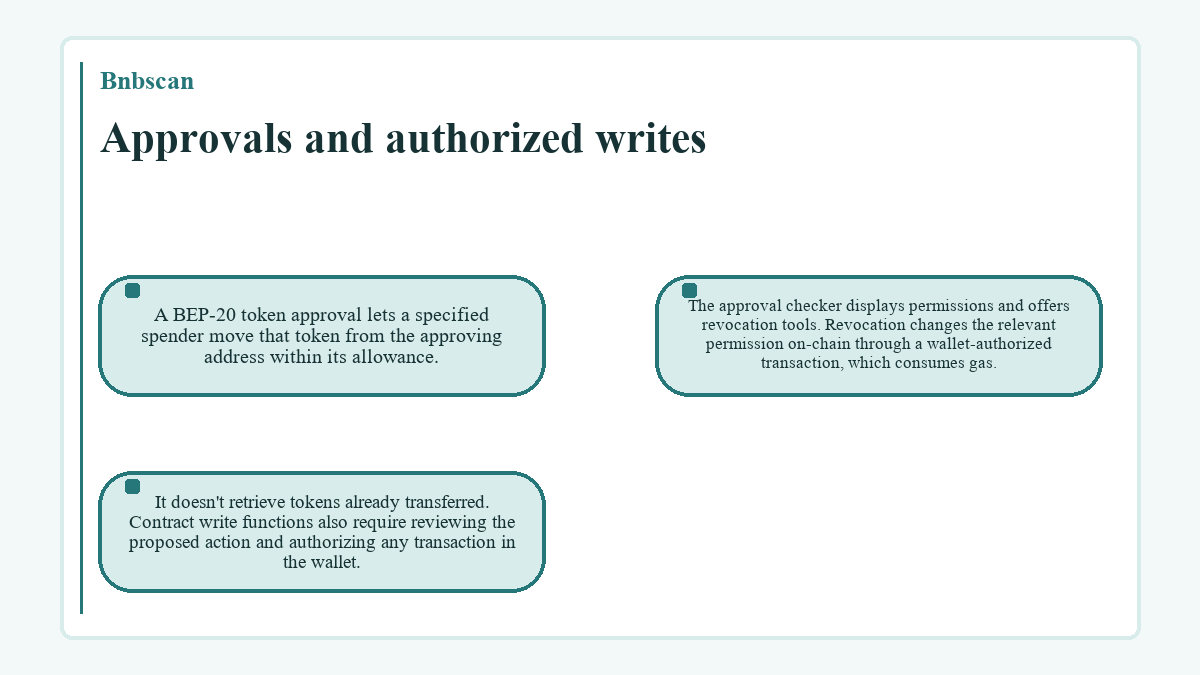
A BEP-20 token approval lets a specified spender move that token from the approving address within its allowance. The approval checker displays permissions and offers revocation tools. Revocation changes the relevant permission on-chain through a wallet-authorized transaction, which consumes gas. It doesn't retrieve tokens already transferred. Contract write functions also require reviewing the proposed action and authorizing any transaction in the wallet.
Gas charges and execution limits
Transaction fees pay for computation on BNB Smart Chain in BNB. Gas used measures the work execution consumed; gas limit caps the work the transaction permits. Multiplying gas used by the transaction's effective gas price in BNB per gas gives its execution fee in BNB. One Gwei equals 0.000000001 BNB. A token's transfer amount therefore uses a different unit from the network charge.
The gas tracker estimates suitable prices from network activity, and those estimates change. Its suggested price doesn't promise inclusion by a particular time. A higher gas limit permits more computation. A revert caused by an insufficient token balance requires resolving that balance condition. The transaction's fee field records its execution charge, separate from any fee a token contract or application imposes.
Blocks, validators, and network charts
Block records place transactions in chain order and identify the validator associated with block production. They show the block timestamp, included transaction count, gas used, and gas limit. A block's transaction count excludes internal contract calls the explorer lists separately. Network utilization describes used gas relative to capacity for the stated blocks; it doesn't count how many people used the network.
Validator views and network charts extend the analysis beyond one account. Daily transaction totals and average gas-price charts describe activity over their displayed windows. Their scopes differ from a single transaction's charge or an individual token's transfers. A traffic spike alone doesn't explain its cause, and a historical average doesn't predict the cost of a future contract call.
CSV exports and programmatic access
CSV exports provide downloadable records for a selected address and range, subject to export limits. A file covering one activity type doesn't automatically include other categories. APIs support repeated data retrieval. Etherscan API V2 includes BNB Smart Chain queries using a chain ID and API key; endpoint availability and request limits depend on the plan and chain. Browser searches, downloaded files, and API responses serve different retrieval needs without changing the underlying network record.
Public history and network boundaries
Public address lookups expose transaction history and balances without establishing the legal owner of an address. Labels add context, while account activity can reveal relationships between transfers. Sharing a hash or address can disclose more financial history than the single payment someone asks about. Passwords, seed phrases, and private keys have no role in a public record lookup.
Network context also limits conclusions about missing activity. An address can exist across compatible networks, with different balances and histories in each. BNB Smart Chain, its testnet, and opBNB have separate records; checking one doesn't establish what happened on another. The explorer also relies on indexing data, so missing results alone don't prove a failed transfer. BNB Smart Chain mainnet uses chain ID 56, while its testnet uses chain ID 97.
Bnbscan: what people ask
Do I need to connect a wallet to search Bnbscan?
Public transaction and address lookups don't require a wallet connection. Searching reads blockchain records and doesn't authorize spending. Account features such as watch lists and private notes require an explorer login. Actions that change blockchain state, including revoking a token approval, require authorization from the relevant wallet and can incur network fees.
Why does my wallet omit tokens listed by the explorer?
A wallet can omit a token because it hasn't added the contract or is displaying a different network. To display tokens after a successful transfer to your address, the wallet must support the relevant token standard and network. Importing the correct token contract can enable its display; it doesn't move the token or alter its balance.
Does hiding a spam token remove its on-chain history?
The Private Token Ignore List only changes what your logged-in explorer account displays. It can hide selected contracts from holdings views and exclude their values from displayed totals. It doesn't erase transfer events, burn tokens, or change balances on the blockchain. Other people can still inspect the original public records.
Can Bnbscan reverse a transfer to the wrong address?
The explorer can't reverse a successful transfer or recover the recipient's private keys. A return requires action from whoever controls the receiving address. If a receiving service controls it, recovery depends on that service's procedures and capabilities. A visible transaction record helps identify what happened without giving the explorer authority over the funds.
What does a dropped and replaced transaction mean?
Dropped and replaced means another transaction from the same sender, using the same nonce on that network, took its place and entered the chain. The replacement has its own transaction hash. Its destination and action can differ from the original submission, so the original hash alone doesn't establish what ultimately executed.
Which details belong in a payment support request?
A payment support request should identify the network, transaction hash, receiving address, and asset involved. Include the token contract when similar names could cause confusion, and explain the difference between the expected receipt and the displayed record. Direct account-credit questions to the receiving service. A support request doesn't require your seed phrase or private key.