 Bnbscan
 token approvals and revocation mechanics
Bnbscan token approvals concern the BEP-20 spending permissions a wallet owner can inspect and revoke on BNB Smart Chain. Each allowance belongs to a particular owner, token contract, and spender. Revocation changes the selected permission to zero through an on-chain update. A signed request or transaction hash alone doesn't establish that the change has taken effect.
· updated
An allowance can outlive the swap or deposit that prompted it. The remaining permission, the account's token balance, and the cost of removing access describe different things, so each affects a different decision.
Selecting the permission before revocation
Enter the owner's public address in the explorer's token approval checker to inspect allowances. Before authorizing revocation of a selected allowance, connect the owning wallet on BNB Smart Chain and, for a sender-funded transaction, check it has enough native BNB for gas. If the connected account or network doesn't match that allowance, correct the selection before authorizing the change.
Owner and network
The owner is the address whose tokens the spender can use. The wallet authorizing a standard
approve
call must control that account. BNB Smart Chain mainnet uses chain ID 56. Another network has separate token and allowance records, even when the account address matches. The wallet's selected account and network therefore need to match the permission under review.
Token contract and spender
The token contract holds the allowance, while the spender receives authority to use it. Token names alone don't identify that contract. Compare its address and the spender's full address with the permission you intend to remove. Revoking one spender leaves a different spender's allowance unchanged, even when both permissions concern the same token.
Allowance reads, approvals, and token transfers
Allowance reads, approval writes, and token transfers perform different operations on the same token contract.
Reading current authority
The
allowance(owner, spender)
function returns the remaining permitted amount without changing contract state. The token balance answers a different question: how many tokens the owner holds. An old approval event describes a past setting; the current allowance answers whether spending authority remains.
Changing the allowance
The
approve(spender, amount)
function writes a spending amount for that token. In a standard owner-signed call, the caller is the owner whose allowance changes. A successful call with amount zero revokes that spender's standard allowance. A nonzero value grants or replaces permission; the plain approval operation doesn't itself transfer the approved tokens.
Using authorized tokens
The
transferFrom(owner, recipient, amount)
function uses spending authority to move tokens. The spender and recipient needn't be the same address. An allowance identifies who may initiate a permitted transfer, without fixing its eventual recipient. The spender can use a standing allowance without requesting another token approval for each permitted transfer. A plain approval also doesn't execute a swap or deposit; that activity follows the application's contract logic.
Does disconnecting a wallet remove its token approvals?
Disconnecting a wallet from an application leaves its existing on-chain token allowances unchanged. The connection controls the application's interaction with the wallet interface. The allowance lives in the token contract, which can continue recognizing the spender after the browser session ends.
Removing a connection also doesn't erase public approval history. An explorer can still display the transactions associated with an address. Ending a session and canceling spending permission serve different purposes: canceling the permission requires a change in the relevant contract.
Gas payment and revocation costs
Sender-funded revocations on BNB Smart Chain require native BNB to cover the transaction's network fee.
Gas measures the computation needed to execute the contract update. The wallet estimates the network fee before submission, and the transaction record provides the eventual charge. The approved token amount isn't the fee base, so revoking an unlimited allowance doesn't charge a percentage of that allowance. The contract's execution requirements and the transaction's gas settings determine the cost.
A wallet can offer another fee-payment route only when it actually supports that route. Sponsorship also depends on the sponsor's eligibility rules. Neither option follows automatically from opening the explorer's approval checker.
An out-of-gas failure can consume BNB without completing revocation. Holding the approved BEP-20 token doesn't itself fund a standard, sender-paid transaction, and no fixed BNB amount covers every contract.
A gas warning before a revocation retry
An unfunded, sender-paid request leaves the allowance active until a transaction successfully changes it. In this hypothetical case, the owner exclusively controls the correct account on BNB Smart Chain, and the chosen token has a nonzero allowance for the selected spender. The wallet blocks submission because the account lacks enough BNB for gas. This route offers neither sponsorship nor payment in another token.
After the account receives enough BNB to cover the wallet's updated fee estimate, the owner reviews the same token and spender, then authorizes
approve(spender, 0)
. That zero is the requested allowance, not a token payment to the spender. A submitted hash identifies the retry while it awaits inclusion. The retry subsequently succeeds, and a current allowance read for that owner and spender returns zero. The selected spender can no longer use that standard allowance. A pending or failed retry would leave completion unresolved, and other token permissions remain separate.
Confirmation and the allowance after execution
Revocation completes when the intended contract update succeeds and the corresponding allowance reflects the requested change.
Submission and execution
A wallet confirmation authorizes a transaction; network inclusion and execution happen afterward. Pending status leaves the outcome unresolved. A failed execution doesn't establish a new allowance, even when it incurs a fee. The transaction's sender, destination token contract, and decoded spender identify which permission the request actually targeted.
Current state and earlier events
The
Approval
event records the owner, spender, and approved value of a successful
approve
call. That event concerns the permission at its point in the chain. Later transactions can change it again, so a current allowance read supplies the relevant value before continuing. An old approval remaining in transaction history doesn't establish that its original permission remains active.
BEP-20 permits a false return value, so a successful transaction status alone doesn't prove every intended token operation succeeded. The updated allowance provides the direct answer about the selected spending permission.
Empty balances and future token receipts
An empty token balance doesn't necessarily remove a spender's remaining allowance for that token.
Balance and allowance are separate contract records. A spender can't take more tokens than the account holds through ordinary token-transfer mechanics. An unused permission may nevertheless cover later tokens arriving at that address. Exposure follows both the available balance and the remaining allowance, along with the token's transfer rules.
Spending can consume a finite allowance, leave a remainder, or leave an unlimited permission active, depending on implementation and the amount used. A completed sale therefore doesn't establish that spending authority has ended. The permission may need a separate revocation even after the wallet no longer holds that token.
Limited and unlimited spending amounts
Limited allowances set a token spending cap, while unlimited approvals leave substantially broader access available to the spender.
A cap applies across the permitted spending, not as a fresh budget for each transfer. Standard finite-allowance implementations reduce the remaining amount as the spender uses it. A later operation needing more than that remainder requires sufficient new authorization. Contract values use the token's smallest units. An interface may use the token's decimals setting to display human-readable amounts. An unlimited label generally represents a very large contract value rather than the account's present balance. Some implementations preserve this maximum allowance when
transferFrom
spends tokens. That behavior avoids recurring approvals, and it keeps future holdings exposed to the same spender.
Replacing an existing nonzero allowance
BEP-20 recommends setting an existing allowance to zero before assigning another nonzero value to the same spender.
That reset concerns changing a continuing permission; full revocation stops at zero. A new
approve
call replaces the stored amount instead of adding another independent permission. Transaction ordering can matter during a nonzero replacement. The spender may use the old allowance before the update and then access the replacement amount afterward. A completed zero reset provides a boundary before granting fresh access, although it can't undo earlier spending. Contract behavior may impose its own requirements on acceptable updates.
Revocation limits after unauthorized spending
Revocation can stop later spending under the removed allowance; it cannot reverse a transfer already executed.
An attacker exploiting an approved spender can use the token permissions the contract recognizes. Removing a different spender or another token's allowance doesn't remove that access. Contract verification allows inspection of published code matching deployed bytecode; it doesn't promise that the code is harmless or immune to exploitation.
A leaked account signing key presents a different problem. Anyone controlling that key can authorize new transactions, so removing an allowance doesn't remove the intruder's signing power. An approval list describes spending permissions, without establishing who else can sign for the account.
Revocation and an existing deposit
Revoking an allowance doesn't withdraw tokens the account already deposited into another contract.
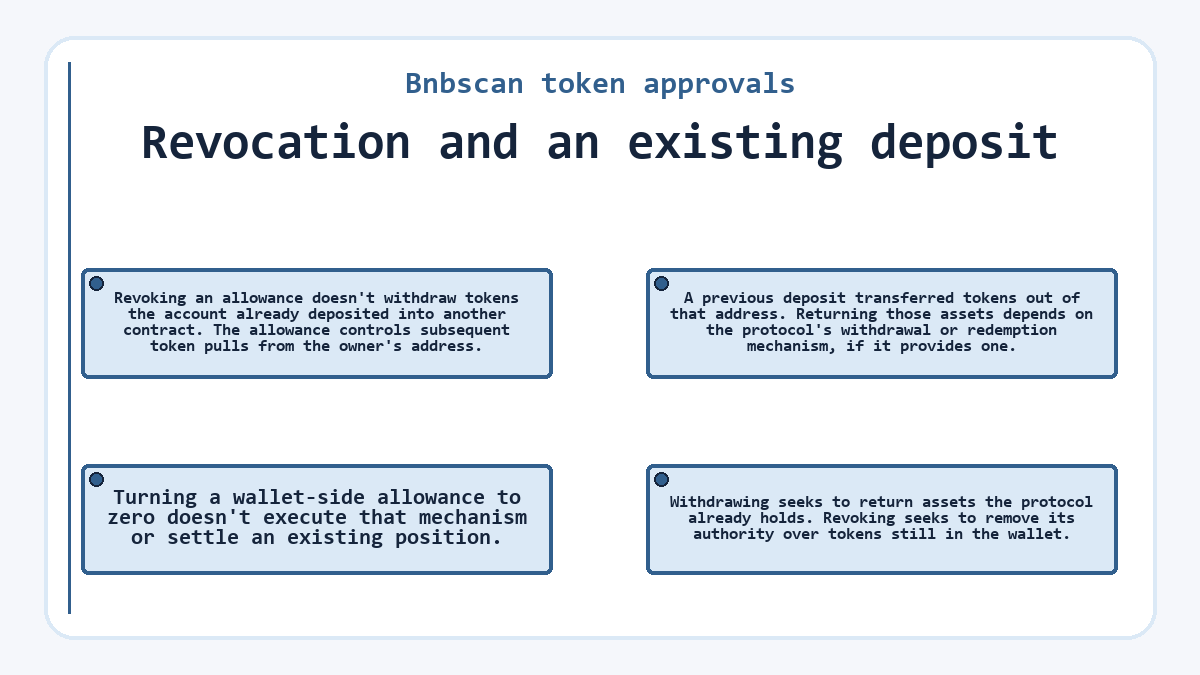
The allowance controls subsequent token pulls from the owner's address. A previous deposit transferred tokens out of that address. Returning those assets depends on the protocol's withdrawal or redemption mechanism, if it provides one. Turning a wallet-side allowance to zero doesn't execute that mechanism or settle an existing position.
Withdrawing seeks to return assets the protocol already holds. Revoking seeks to remove its authority over tokens still in the wallet.
Common questions about Bnbscan token approvals
Do standard BEP-20 approvals expire after a period of inactivity?
The standard BEP-20 approve function has no inactivity timer or expiry parameter. An unused allowance can remain until spending or a later update changes it. Extensions can add other authorization mechanisms with their own rules. An expiry attached to a separate signed authorization shouldn't be assumed to cancel an existing allowance in the token contract.
Does a BEP-20 approval give a spender access to native BNB?
An ordinary BEP-20 allowance doesn't grant spending authority over native BNB. Native BNB pays the network fee in a sender-funded revocation, while the allowance concerns the selected token contract. A wrapped native asset is a token and can have its own allowance. Those are separate balances and permissions, even when their displayed names look similar.
Will revoking a spender prevent incoming token payments?
Revoking a standard allowance doesn't disable ordinary incoming transfers of that token. It removes the specified spender's delegated authority to pull tokens from the account. A sender can still transfer tokens to the owner under the token's rules. A protocol's reward distribution or claim process can have additional requirements, so revocation alone doesn't establish whether a particular reward continues.
Do I need to enter my recovery phrase to revoke an allowance?
A token allowance revocation doesn't require entering a recovery phrase into an explorer or revocation form. The connected wallet handles transaction authorization using credentials it already holds. Disclosing the recovery phrase or private key exposes control of the account. The spender permission can change through the wallet's normal signing process without disclosing either secret to the approval checker.
Which approval matters when the asset is an NFT?
An NFT's token standard determines whether its permission concerns one item or a collection operator. For an ERC-721 contract on BNB Smart Chain, an individual approved address and an operator approval are distinct. Disabling an operator with setApprovalForAll(operator, false) concerns that collection contract. A BEP-20 allowance of zero doesn't establish that either NFT permission has ended.